
For most of America’s beer history, the word “lager” conjures to mind images of Bud Light and PBR, just the mention of it brings forth the smell of frat parties and sports bars, beer pong and flip cup. However, in the last few years, there has been a new awakening: brewers and beer-drinkers alike have cottoned on to what continental Europeans have known for centuries: lagers can be diverse and incredible. More and more breweries around the country are paying homage to a rich and complex history, and lager-centric breweries are becoming more and more popular (a special nod to two of my favorites, Chuckanut in Bellingham, WA, and Jack’s Abby in Framingham, MA), offering up clean pilsners, kellerbiers, and more. I’d like to focus on one of my favorite styles of lager, one which I feel represents the perfect Autumnal tippel: The Doppelbock.
The doppelbocks has yet to garner the fame and attention in the US that it deserves, but I have a feeling its celebrity is right around the corner. As Americans become more and more tuned in to the malty-side of lagers, embracing Czech dark lagers, Vienna lagers, and Festbiers alike, I feel strongly that the doppelbock will soon take its place in the standard American Fall line up. Rich and malty, with a complex and alluring flavor profile, these beers generally boast the higher alcohol content (between 7-10%) that the American public seems to crave. Doppelbocks were originally created by the St Paulaner Friars in Munich (yes, you read that right, and yes, it is indeed related to the Paulaner brewery!). These beers were brewed to be liquid bread for monks during times of fasting, so historical examples tend to be lower alcohol, though the flavor profile and mouthfeel remain very similar. A traditional doppelbock will have an intensely malty flavor profile, with notes of biscuit, caramelized raisin, very faint chocolate, a soft, pleasant fruitiness, and a mild, but distinct alcoholic bite.
Doppelbocks are perhaps a more “advanced lager”, both from a brewing perspective and from a palate perspective. Despite this, I maintain that doppelbocks, and malty European lagers in general, will continue to become more and more popular in American brewhouses, as we all eagerly wait for “the next big thing in beer”. However, if you live near any of the big box booze stores (BevMo, Total Wine, etc), you can easily get ahold of many different traditional doppelbocks. While I encourage you to do your own taste test at home, I have taken it upon myself to help you out by sampling 4 of the most popular and well-respected of the traditional European doppelbocks. I would like to note that none of these beers is “bad”, each of them are very well-brewed, and each has distinct differences that will appeal to various palates.
The taste test was performed blind and included the following:
- Paulaner Salvator (the OG of doppelbocks)
- Spaten Optimator
- Ayinger Celebrator
- Schneider Aventinus
Paulaner Salvator:
A touch lighter in color than the Optimator, with a slight reddish hue. First impressions present burnt toast, raisins, biscuit, a strong molasses bite is accompanied by a hint of vanilla. As the beer warms to room temperature the hotter alcohol notes comes to the fore, slightly aggressive, but not necessarily unpleasant. While Salvator is officially the “original” doppelbock, I would hazard to say that it is nothing like the beer that was originally brewed by Franciscan monks nearly one thousand years ago, which would have been much sweeter and thicker.
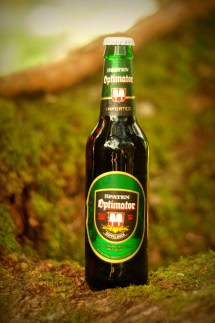 Spaten Optimator:
Hefty flavors of brown sugar and burnt toffee, coupled with graham cracker and caramelized raisin and plum. Slightly lower carbonation helps it go down easier, particularly given the very boozy finish. As the beer comes to room temperature, more of the complex malt character comes through – notes of toasted biscuits, fresh bread dough, a touch of chocolate, and finally the tiniest hint of umami comes forward. Overall, this was my favorite of the bunch, it was full-bodied and flavorful, a fantastic afternoon drink in the crisp, cool autumn air.
Ayinger Celebrator: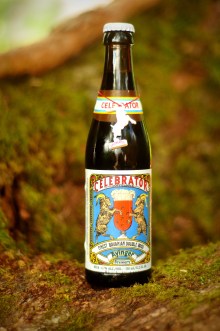
Much darker in color than the other three beers, with a unique ruby glow when held up to light. The immediate impression is of molasses, burnt toast, and roasted chocolate malts. While far from acerbic or astringent, the mouthfeel of this beer is slightly thinner and a bit harsher; the beer tastes far more alcoholic than the rest, and has the lightest body, which perhaps contributes to the perceived harshness. As the beer warms up, more complex caramelization flavors come through – burnt sugar and breadcrumbs at the fore. Overall, this was my least favorite of the bunch.
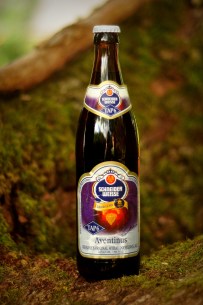 Schneider Aventinus:
While Aventinus strays away from the original style, taking on a hefeweizen-style bent, I felt it was important to include, as it is often presented in both craft beer bars and in bottle shops as a doppelbock. The first sip tastes of pear drops, brown sugar, and booze, with lingering flavors of bread dough and toffee. As the beer warms, hints of banana and cinnamon play in the background, while caramelized raisin and vanilla come to the foreground. The beer has quite a hefty mouthfeel, and while drinking this I can understand why the monks used it as a liquid bread! Generally speaking, I enjoyed this beer, though I would hesitate to call it a “doppelbock”, as I think it has more in common with a traditional weizenbock (a topic for another day!).
The main takeaway from this experiment is this: if you’re not interested in stouts, but are looking for a beer that will stick to your bones and keep you warm on a cold Autumn day, doppelbocks are certainly a winner. Moreover, this meaty and rich beer holds up to some quite intense flavors when pairing with food. The sweetness and emphasis on maillard reactions hold up well to strongly flavored game meats or roasted pork, as well as some of the more intense italian cheeses (think taleggio or gorgonzola). Drink up and enjoy!
 Beer Ye, Beer Ye!