
Towards the end of August, as summer draws to a close, a distinctive aroma hovers in the air in the Yakima Valley – verdant and bright, the smell of the hop harvest is intoxicating. This season is pivotal for the farmers of Yakima, who reap the rewards of a full year of labor in a few short weeks.
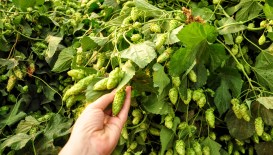 I was lucky enough to visit the valley to witness the harvesting and processing of these little green beauties, including trips to the well-known Crosby Hop Farm and Virgil Gamache Farms. Walking through the fields, taking in the heady aroma, noting the subtle changes in smell as we wandered past different varietals was somewhat of a magical experience: pithy grapefruit and pine clings to the air as we pass the Simcoe, while hints of lemon waft by us near the Amarillo. The buds are plump and sticky, bursting with lupulins – the resinous yellow powder containing the compounds and oils that impart the hops’ flavor and aromatics.
Large tractor-like machines pace up and down the rows, cutting the hanging vines, 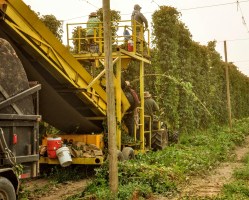 stripping leaves and buds off wholesale, and flinging the now-bare leftovers behind and delivering the rest back to the facility. The processing facility is a maze of hop ladders, carrying hops in different directions depending on their stage in the process. When the hops are fully cleaned and separated, they are transported up to be dried out by a particular chute lovingly referred to as the “stairway to heaven”. My eyes widen as I see a veritable ocean of hops drying and being packaged at the other end of the facility. While each farm processes their crop slightly differently, using different machines of varying degrees of technological advancement, the core remains the same: pick, sort, dry, package. The whole buds can then either be sent to breweries as is, or to a plant down the street to be either pelletized or extracted (another incredible process unto itself!).


Beyond the hop processing, breweries delight in receiving bushels of freshly picked hops, to be brewed with immediately and released as soon as possible in order to retain as much fresh and bright flavor and aromatics as possible. The flavor produced by fresh hops is quite different from that of the processed hops. It imparts a grassy, slightly herbal flavor, which brewers refer to as “green”. Additionally, the aromatics usually associated with each varietal of hop, while still present, is more delicate and subtle, and just a touch sweeter.
Beginning in late September and continuing through to early October, fresh hop beers start appearing all over the city, creating a particular buzz in the Seattle area. Numerous festivals exist solely to display these incredible and unique creations. Beveridge Place Pub in West Seattle holds an annual Fresh Hop Festival, featuring no less than 30 beers from around the state. However, the Yakima Fresh Hop Festival certainly takes the cake (the yeast cake, perhaps?)! Taking place next weekend, this is one of the largest fresh hop festivals in Washington, boasting over 60 breweries big and small from all over the country there to show off their creations in the heart of America’s hop-land.
Don’t miss out on these brews, they only come once a year and they never last long – the aromatics and flavors of these fresh hop brews volatize and dissipate quickly, altering the flavors tremendously after very short periods of time. This means that the best time to get a fresh hop beer is asap! And a top tip to those new to the game: if a brewery has had their fresh hop beer on more than 3 weeks after it was packaged, it’s unlikely to be as bright and intense as it should be, so skip it over and order the other late September favorite: an Oktoberfest lager!
 Beer Ye, Beer Ye!